
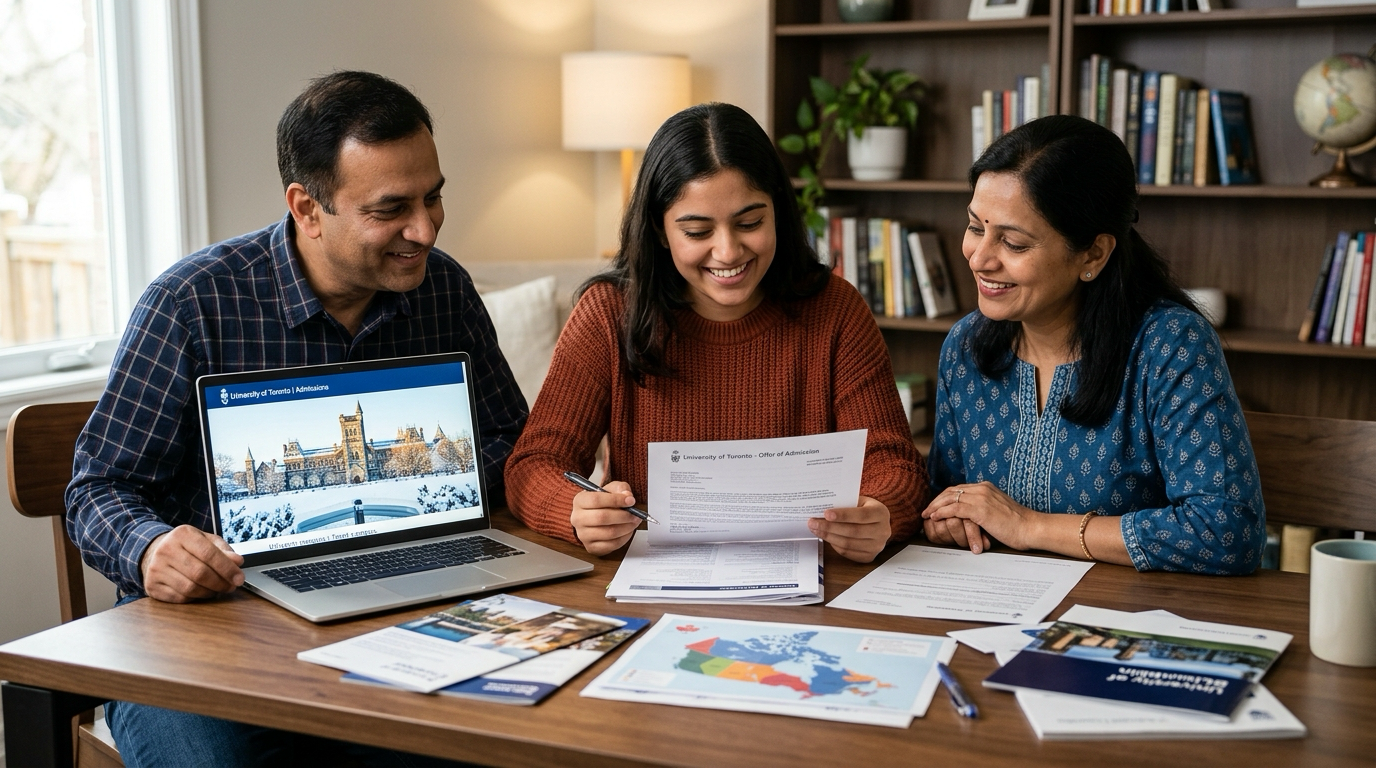
Canada Student Visa Guide for Indian Students (2026): PAL, GIC, Rules & Process
Understand Canada’s 2026 study permit rules, including PAL/TAL requirements, the current CAD $23,448 living-expense threshold, PGWP eligibility, and acceptable financial evidence.
Canada study permit rules in 2026: what has changed?
Navigating a Canadian study permit application in 2026 requires understanding policy updates implemented by Immigration, Refugees and Citizenship Canada (IRCC). The landscape has moved toward controlled intake caps, mandatory Provincial Attestation Letters (PAL), increased financial thresholds via Guaranteed Investment Certificates (GIC), and targeted Post-Graduation Work Permit (PGWP) eligibility criteria.
For Indian applicants—who represent one of the largest international student communities in Canadian colleges and universities—a successful visa file demands meticulous document alignment, authentic proof of funds, and a clear explanation of how your Canadian credential advances your career upon return.
The Provincial Attestation Letter (PAL): what it is and who needs it
Under IRCC’s revised intake model, most post-secondary study permit applications must include a Provincial Attestation Letter (PAL) issued by the province or territory where the Designated Learning Institution (DLI) is located. When a college or university issues an admission offer, it requests an allocation spot from the provincial quota. Once confirmed, the province issues the official attestation document that must accompany your IRCC submission.
Applicants exempt from the PAL requirement generally include primary and secondary school students, master’s degree and doctoral candidates, and existing in-Canada study permit holders applying for extensions. Always verify whether your chosen qualification level requires a PAL before submitting your IRCC portal file.
Updated financial requirements: CAD $23,448 for one applicant
For applications submitted on or after September 1, 2026, IRCC requires a single study permit applicant outside Quebec to show CAD $23,448 for first-year living expenses. This amount excludes tuition and transportation. Applicants must also show how they will pay tuition and travel, and for programmes longer than one year explain how they plan to fund the full duration of study.
A Guaranteed Investment Certificate (GIC) from a Canadian financial institution is one possible form of proof—not a universal requirement. IRCC also lists eligible bank statements, Canadian bank accounts, education loans, scholarships, tuition or housing receipts supported by other funds, and documented financial support among the examples it may accept. Provide enough genuine, traceable evidence to cover all required costs and explain the source of funds.
DLI verification and PGWP eligibility
Every institution you apply to must have a valid Designated Learning Institution (DLI) number. Furthermore, IRCC has introduced stricter boundaries regarding Post-Graduation Work Permit (PGWP) eligibility. Graduates from public colleges and university degree programmes generally remain eligible, but public-private curriculum licensing programmes no longer qualify for PGWPs.
Before paying application or tuition fees, check both the official IRCC DLI list and the specific programme’s PGWP eligibility. Aligning your qualification with labor-market demand in high-growth fields (such as technology, engineering, healthcare, and skilled trades) strengthens both your academic purpose and long-term career value.
Step-by-step application process for Indian students
- Step 1: Choose a recognized DLI and verify PGWP eligibility for your specific programme.
- Step 2: Submit institutional applications, fulfill prerequisites, and receive an official Letter of Acceptance (LOA).
- Step 3: Follow your institution’s process for obtaining any required Provincial or Territorial Attestation Letter (PAL/TAL).
- Step 4: Prepare acceptable proof covering tuition, transportation, and at least CAD $23,448 in first-year living expenses for one applicant outside Quebec. A GIC may form part of the evidence, but it is not the only option.
- Step 5: Complete any medical examination requested under the current IRCC instructions.
- Step 6: Prepare a personalized Letter of Explanation connecting your academic past with your Canadian studies.
- Step 7: Submit through the official IRCC process, pay the applicable fees, and complete biometrics when instructed.
Writing an effective Letter of Explanation (SOP)
In a Canadian visa file, your Letter of Explanation (LOE) gives the visa officer the context behind your academic and professional decisions. It should clearly explain why you selected this particular Canadian programme over options available in India, how the curriculum bridges any gaps in your prior education, and how your family finances the overall expense without financial hardship.
Crucially, demonstrate strong family, economic, or career ties to India. Mention specific prospective job profiles and employers in India that value international credentials in your field. Generic templates or exaggerated statements can severely damage credibility.
Common reasons for Canadian visa refusals
- Failing to establish that you will leave Canada at the end of your authorized stay.
- Selecting a course unrelated to your previous academic or employment history with no logical explanation.
- Insufficient proof of funds, lack of tax returns (ITRs) for sponsors, or unexplained recent cash deposits.
- Submitting an LOA from a non-qualifying institution or omitting the mandatory PAL where required.
- Discrepancies in academic transcripts, study gap documentation, or employment experience certificates.
Frequently asked questions
Is a GIC compulsory for Indian students applying to Canada?
No. IRCC lists a GIC as one example of proof of financial support, alongside options such as eligible bank statements, Canadian bank accounts, education loans, scholarships, and documented financial support. Your evidence must cover tuition, transportation, and the applicable living-expense requirement.
Do master’s and PhD students need a Provincial Attestation Letter (PAL)?
No. As per current IRCC guidelines, master’s and doctoral degree applicants are exempt from the PAL requirement and the provincial cap, though they must still provide an official Letter of Acceptance.
Can I work while studying in Canada?
Eligible full-time international students at DLIs can work off-campus up to the officially permitted hours per week during regular academic sessions (currently up to 24 hours per week during study terms) and full-time during scheduled academic breaks.
What English test scores are accepted for Canadian study permits?
IRCC accepts IELTS Academic, PTE Academic, and TOEFL iBT, as well as IELTS General Training and CELPIP for specific streams. Always ensure your test meets both your DLI’s admission threshold and IRCC’s standards.
Official sources
Information reviewed on 1 September 2026. Always recheck rules and deadlines before applying.